Biopsy Tumors
Biopsy Tumors
Biopsy is the cornerstone of accurate diagnosis in bone and soft tissue tumors, enabling differentiation between benign, malignant, and metastatic lesions while determining the exact subtype essential for treatment planning.
A biopsy involves obtaining a representative tissue sample for histopathological examination, immunohistochemical staining, and molecular studies. There are two main approaches: needle biopsy (fine-needle aspiration or core needle) and open (incisional or excisional) biopsy.
Dr. Pradeep Kumar, with extensive musculoskeletal oncology training from Tata Memorial Centre, emphasizes that needle biopsy is preferred whenever feasible—minimally invasive, performed under image guidance (ultrasound/CT), offering quick recovery and low complication rates. Core needle biopsy provides adequate tissue for diagnosis in over 90% of cases when performed by experienced hands.
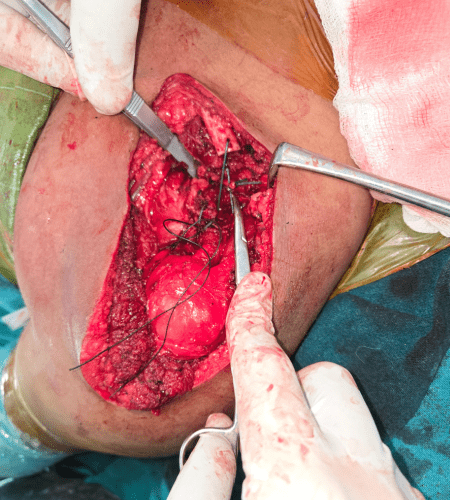
Open biopsy is reserved for complex or inaccessible lesions. Critical principles include proper planning of incision along future surgical lines, meticulous hemostasis, and avoiding contamination of unaffected compartments—errors can compromise limb-salvage possibilities.
Advanced techniques like frozen section analysis during surgery guide immediate decisions. Molecular testing on biopsy samples identifies specific mutations (e.g., IDH in chondrosarcoma, EWS-FLI1 translocation in Ewing sarcoma), enabling targeted therapies.
Accurate biopsy by a specialized orthopaedic oncosurgeon ensures correct diagnosis, prevents unnecessary procedures, and optimizes outcomes. Any suspicious lump, persistent pain, or swelling warrants early referral—timely, expert biopsy is the first step toward effective treatment and cure.
Open biopsy is reserved for complex or inaccessible lesions. Critical principles include proper planning of incision along future surgical lines, meticulous hemostasis, and avoiding contamination of unaffected compartments—errors can compromise limb-salvage possibilities.
Advanced techniques like frozen section analysis during surgery guide immediate decisions. Molecular testing on biopsy samples identifies specific mutations (e.g., IDH in chondrosarcoma, EWS-FLI1 translocation in Ewing sarcoma), enabling targeted therapies.
Accurate biopsy by a specialized orthopaedic oncosurgeon ensures correct diagnosis, prevents unnecessary procedures, and optimizes outcomes. Any suspicious lump, persistent pain, or swelling warrants early referral—timely, expert biopsy is the first step toward effective treatment and cure.